
Designing the Digital Handmaiden: How AI Design Encodes Gender Bias
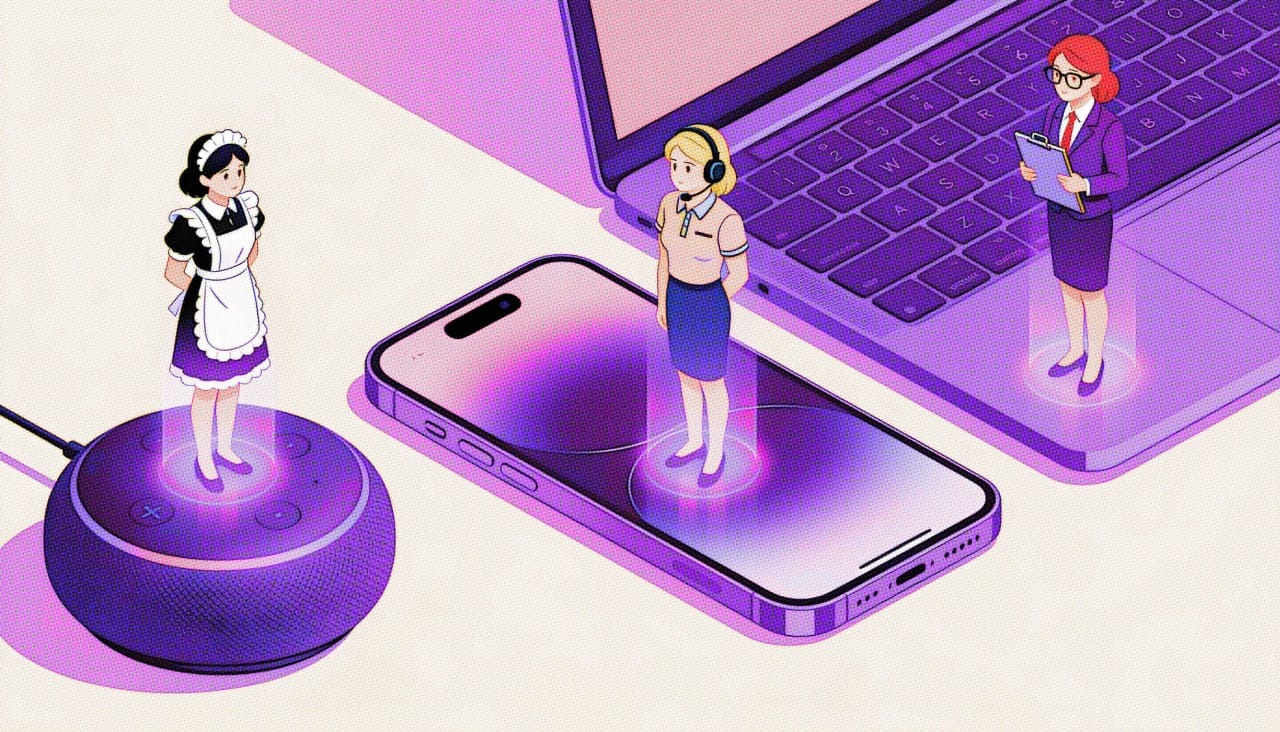
DESIGNING THE DIGITAL HANDMAIDEN: HOW AI DESIGN ENCODES GENDER BIAS Dr. Asegul Hulus explores the default feminization of AI assistants, the current state of women in STEM, and the performative use of gender equity by organizations for a virtuous public image.
Her name is Alexa. Her name is Siri. She will answer your questions, manage your calendar, play your music, and apologises if she misunderstands. She does not have a surname. She does not have a salary. She does not have a promotion track. She does not complain. This is not a coincidence. It is a design choice and that design choice tells us everything we need to know about where women still stand in science, technology, engineering, and mathematics (STEM).
The default feminization of artificial intelligence (AI) assistants is not a neutral branding decision. It's indicative of a long-standing system that prefers women to serve rather than to hold positions of power. We built artificial women to do the work we once forced real women to do for less money, less credit, and less respect. And then we called it innovation.
The Digital Handmaiden
So how do we explain Alexa? Siri? Microsoft's discontinued Cortana? Gemini, whose initial default voice was female? OpenAI's ChatGPT, whose most publicised voice launch deliberately evoked a female AI character from cinema, a voice so reminiscent of actress Scarlett Johansson that she hired legal counsel in response. Voice assistants, old and new, that reach for a woman's voice first, before users have the option to change it?
The answer? The tech industry has not relinquished its patronizing stance towards feminized work. It has simply automated it, feminising the roles that are designed to assist. The helpful, responsive, and consistently available assistant, who never makes excessive demands, represents an enduring archetype in gendered service roles.
What changed is that we no longer need a human woman to fill the role. We can generate her voice from a database, give her a name that sounds friendly but not threatening, and deploy her at scale. She will not ask for a pay rise. She will not report to Human Resources (HR). She will not leave.
This is not an unconventional observation. Research, for example by Ramona Vijeyarasa, consistently shows that users interact with female-voiced AI assistants more harshly, even sexually, more dismissively, and with less patience than male-voiced ones, and that they expect female-voiced assistants to apologise more. We have not just built digital assistants. We have built digital women, and we have built them to absorb the same behaviours that have always been directed at real ones.
Moreover, MetaTech Feminism, the framework I founded, asks us to look at who benefits from the design choices embedded in emerging technologies, and who is harmed. Viewing AI assistants through this perspective reveals an uncomfortable truth. Their design inherently embeds, validates, and perpetuates the notion that helpfulness, compliance, and service are characteristics associated with femininity. That is not progress. That is the same system in a new shell.
The State of Women in STEM: The numbers they would rather not read aloud
The data on women in STEM is, at this point, exhaustingly familiar. Women hold approximately 28% of computing jobs. They make up just 26% of the AI and machine learning workforce in the US according to Deloitte. In senior technical roles, the figure drops further. Women of colour hold just 6% of C-suite positions (highest-ranking senior executives), according to Axios, a number that has barely moved in a decade.
As I noted in "Fork the System", women made up 38% of programmers in the United States by 1984. Then software became profitable. Within a decade, that figure began to fall. Today, women make up approximately 28% of the programming workforce, a smaller share than they held forty years ago, in an industry that has grown from half a million jobs to over five million. The more the field expanded, the more women were squeezed out. This is not a paradox. It is a pattern.
In 2025, global reporting confirmed that women in programming are paid, on average, 82 cents for every dollar earned by male colleagues in equivalent roles. At senior levels, that gap widens to as much as 31%. The field that was once built by women, and built well, now pays women less to participate in it.
These numbers do not reflect a pipeline problem. There is no shortage of qualified women. There is a shortage of organisations willing to hire, retain, promote, and pay them equitably. The "pipeline" narrative serves as a diversion, shifting blame to women's decisions and readiness instead of acknowledging the systemic barriers intentionally put in place to keep them out.
Equity as aesthetics
Here is the question we need to ask more loudly:
Are organisations actually committed to gender equity, or are they committed to the appearance of gender equity?
The distinction matters enormously. In recent years, we have seen a proliferation of women-in-tech initiatives, Diversity, Equity, and Inclusion (DEI) pledges, inclusion reports, mentorship programmes, and International Women's Day blog posts. Some of this work is genuine. A great deal of it is not. It's about appearing equitable rather than being truly equitable, offering the "look" of inclusion without the necessary fundamental shifts.
How do we know the difference? Ask where the money goes. Ask whether women are being hired into senior technical roles or into HR and communications. Ask whether pay gap data is publicly disclosed or buried. Ask whether the organisation's leadership team looked the same five years ago as it does today. Ask whether women who raised concerns about culture were promoted, or whether they quietly left.
The International Women's Day LinkedIn post does not cost anything. Closing the pay gap does. Restructuring recruitment to remove systemic bias does. Holding senior leaders accountable for retention rates does. The organisations that are serious about equity do the expensive things. The ones performing equity do the cheap things loudly.
This performative instinct is not unique to corporate boardrooms. Popular culture has started to notice it too. The forced moment in Marvel's Avengers: Endgame movie where every female character unites on screen was met with an audience reaction that said it all. Watch it here and decide for yourself.
Amazon Prime's The Boys tv series went further, satirising it directly with the line "girls get it done," holding up a mirror to exactly this kind of hollow spectacle. When even superhero franchises are being called out for performing feminism rather than practising it, the question for organisations is whether they want to be the Avengers moment, or something that actually changes the story.
This is not cynicism. It is pattern recognition. When programming was low-status, women were welcome. When it became lucrative, women were excluded. Now that exclusion is reputationally costly, organisations are welcoming women back into the display cases. The press releases, the panels, the case studies, while the actual technical work, the promotions, and the pay remain stubbornly concentrated elsewhere.
The question that keeps following me
I have been told, across a career in computing, that women are too emotional for technical work. That gender equity research in computing, engineering, and STEM overall somehow makes me abnormal. That a passion for this field requires justification, while the same passion in a male colleague is taken as evidence of competence. There was even a time when I was conducting research into protecting children and marginalised genders online from harm and explicit content, and I was called a socialist for it, told I should be programming instead.
Now, not to toot my own horn, but I do programme, I do cybersecurity, I make games, AI, you name it, I work across other computer science fields, and I teach my students everything they need on the technical side of computing. But apparently, I am not a real computer scientist because I also focus on protecting people from harm. Talk about a double standard. I can programme and protect people too.
As I once again wrote in "Fork the System," what remained consistent was the message that any woman who steps outside the narrow template of what a computer scientist is supposed to look like will be punished for it. These messages do not need to be shouted. They simply need to be repeated, quietly and persistently, until the woman who pushes back looks like the problem, and the system doing the pushing remains invisible.
The danger is not that women are too emotional for computing. The danger is that systems repeatedly pathologize women who do not comply, then use their survival responses as evidence against them. When AI systems are designed to be feminine and submissive, they do more than just echo existing gender stereotypes. They teach them.
And this is not confined to programming. In the "Women in Learning: State of the Industry Report 2025," which I co-authored with Mark Gash and Sharon Claffey Kaliouby, we highlight a similar situation within Learning and Development (L&D). While women constitute 65% of the workforce, they occupy less than 20% of C-suite roles. The field changes. The pattern does not.
What we should be asking instead
The question is not whether organisations should do more for women in STEM. The question is whether they intend to, and how we hold them to account when they do not.
Here are a few things worth demanding.
- Transparent pay gap reporting, disaggregated by race as well as gender.
- Promotion rate data for women versus men at equivalent experience levels.
- Exit interview data.
- Independent audits of AI systems for gender bias, including voice design.
- Funding for well-vetted research is crucial. This research should focus on the systemic reasons behind women's exclusion from technical fields, rather than solely on individual psychological factors.
And perhaps most importantly:
Stop naming AI assistants after women while women remain excluded from leadership.
We see exactly what this represents. It is deliberate. It is harmful.
Dr. Asegul Hulus is an Assistant Professor in Computer Science and a Fellow of the Higher Education Academy (FHEA). She is a distinguished researcher and published author with expertise across multiple Computer Science disciplines. She serves on the ACM Council on Women in Computing (ACM-W), where she is an investigative journalist and is on the Global Chapters Committee. She is also the founder of MetaTech Feminism, a pioneering framework at the intersection of technology and feminist research.




Member discussion