Dear Gencifier... It’s Not Me, It’s You.
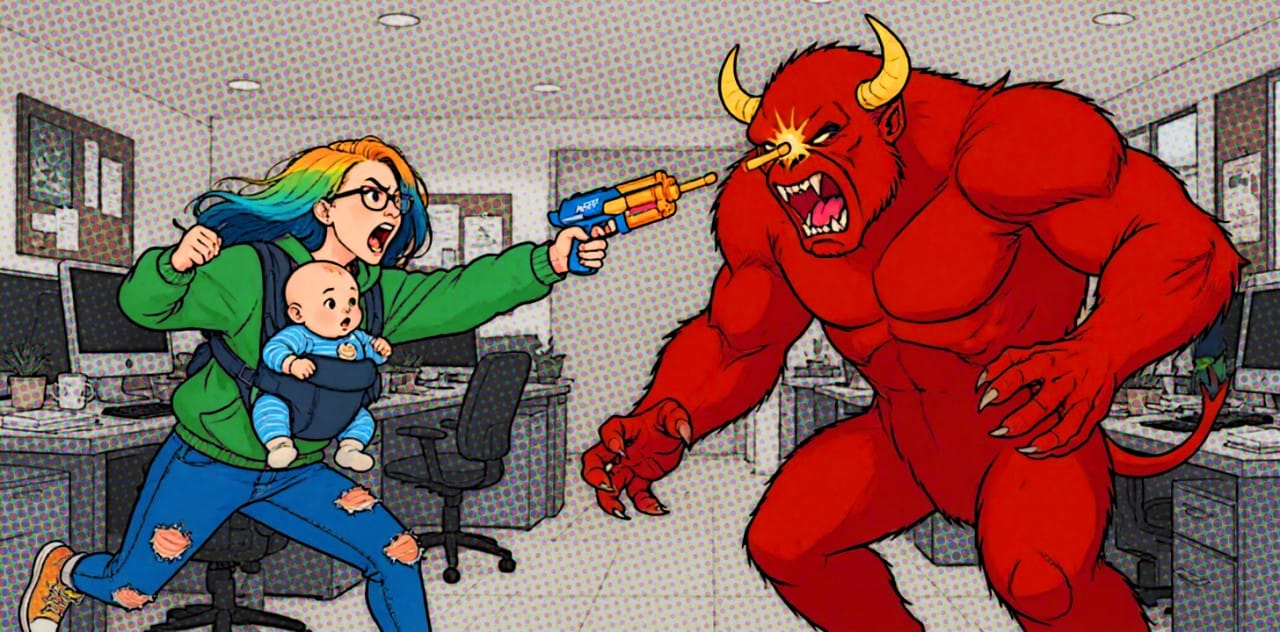
DEAR GENCIFIER... IT'S NOT ME, IT'S YOU Emma Jones doesn't need your male dominance, thank you very much.
I have been doing this long enough to know exactly what I am doing.
I’m not “comfortable with the basics.” Not “still finding my voice.”
I can walk into a chaotic brief, a vague stakeholder request, or a half-baked “we need training” conversation and turn it into something structured, intentional, and effective.
I know how people learn. I know how to design for behaviour change.
I know how to translate complexity into clarity without dumbing anything down, especially where technical training is concerned.
So why am I here?
Well, I’ve heard there is still some guy running around who seems to be stuck in the dark ages. And I’ve met him before.
This guy showed up in rooms where I was the most experienced facilitator. The most qualified to make a judgement call on what should or should not be included in a roll out of some significant importance. I’d made it to the top of my game (well, as far as I was going to go without an additional appendage that shall remain nameless) and I was happy there, and damn good at it to boot.
But then I had a baby (and that’s not the worst of it…) Then I had ANOTHER ONE! (screaming emoji).
And the worst part is I thought I was immune. I STILL hadn’t experienced that gnawing self-doubt. I knew I was good and I was damn well going to come back from maternity leave and take up my rightful place as… THE FINANCIALS GIRL. (LOL IKR)
So off I went, then bumped right into the Gencifier, and in my undefended state received an almost fatal blow. Maybe I’m not actually as good as I think I am.
That feeling didn’t appear out of nowhere. It wasn’t born in isolation. It wasn’t some internal defect quietly living inside me. It was introduced… nay – installed – if you will, in my post-partum brain and it’s never really gone away.
We talk about imposter syndrome as if it’s a personal flaw. A mindset issue. Something fragile or lacking within the individual. What I’ve experienced is that imposter syndrome seems to be an external affliction installed through repeated exposure to subtle undermining and dismissive behaviour.
For me this looked like:
- My recommendations were challenged more aggressively than less-informed suggestions.
- Sometimes my ideas were ignored until repeated by someone else, usually male, then suddenly taken seriously.
- Lower expectations of what I could handle; “That’s too large a group”, “You can’t turn that around in time,” – when before my children these are the things I was knocking out of the park.
EW.
I recently had the absolute privilege of attending the Women in Learning lecture at Learning Technologies 2026 with Sharon Claffey Kaliouby who is an absolute force of nature, and she got me thinking hard about what we do about changing what seems to (still) be the status quo.
In my naivety I really thought we were doing OK. But sat in that presentation, I realised that I’m surrounded by women, like me, who have experienced this… malady. I went back to work and ran a session with my team and learned of some experiences my colleagues have had that are truly upsetting. We don’t seem to have the army of allies I thought we did… and what’s worse; we are blaming ourselves for that.
Now don’t get me totally wrong… I’ve worked with some truly wonderful and supportive individuals (men and women) in my career and seen peers praising each other regularly, and that’s all really great, but I’ve learned that if we are to defeat the Gencifier, we’re going to need a much more targeted approach.
We need to start being very deliberate in the way we champion ourselves and each other. And guys, we need your help: “Women overall are less likely to have sponsors—and this really matters. Employees with sponsors are promoted at nearly twice the rate of those without.” ‘Women in the Workplace 2025’ - McKinsey & Company.
- We need to look for chances to speak positively about our work in meetings, updates, and decision-making spaces, and if we know one of our peers can do something better, we need to speak about them!
- We need to recommend ourselves for visible work, assignments and presentations. No more hoping someone else will do it for us. (I am so bad at this one.)
- We need to seek out networks that can open doors for the things we want to achieve.
So Gencifier:
I don’t need to prove my capability every time I speak.
I don’t need to dilute my decisions to make them more palatable.
I don’t need to internalise doubt that was introduced by environments that can’t recognise what I bring.
Good day to you!
Emma Jones is an innovative, creative training and learning development professional with a focus on strategic development and deployment of training materials. She is particularly passionate about technical learning and has many years' experience designing and delivering enterprise scale solutions that upskill and motivate learners.
Connect with Emma here: https://www.linkedin.com/in/emmagribble/


Member discussion