Dead On Arrival
DEAD ON ARRIVAL Why Beautiful E-Learning Fails, and How Real Expertise Can Save It. By Liz Kollias & Natalie Wieland
Online learning.
Wait, do we still have your attention?
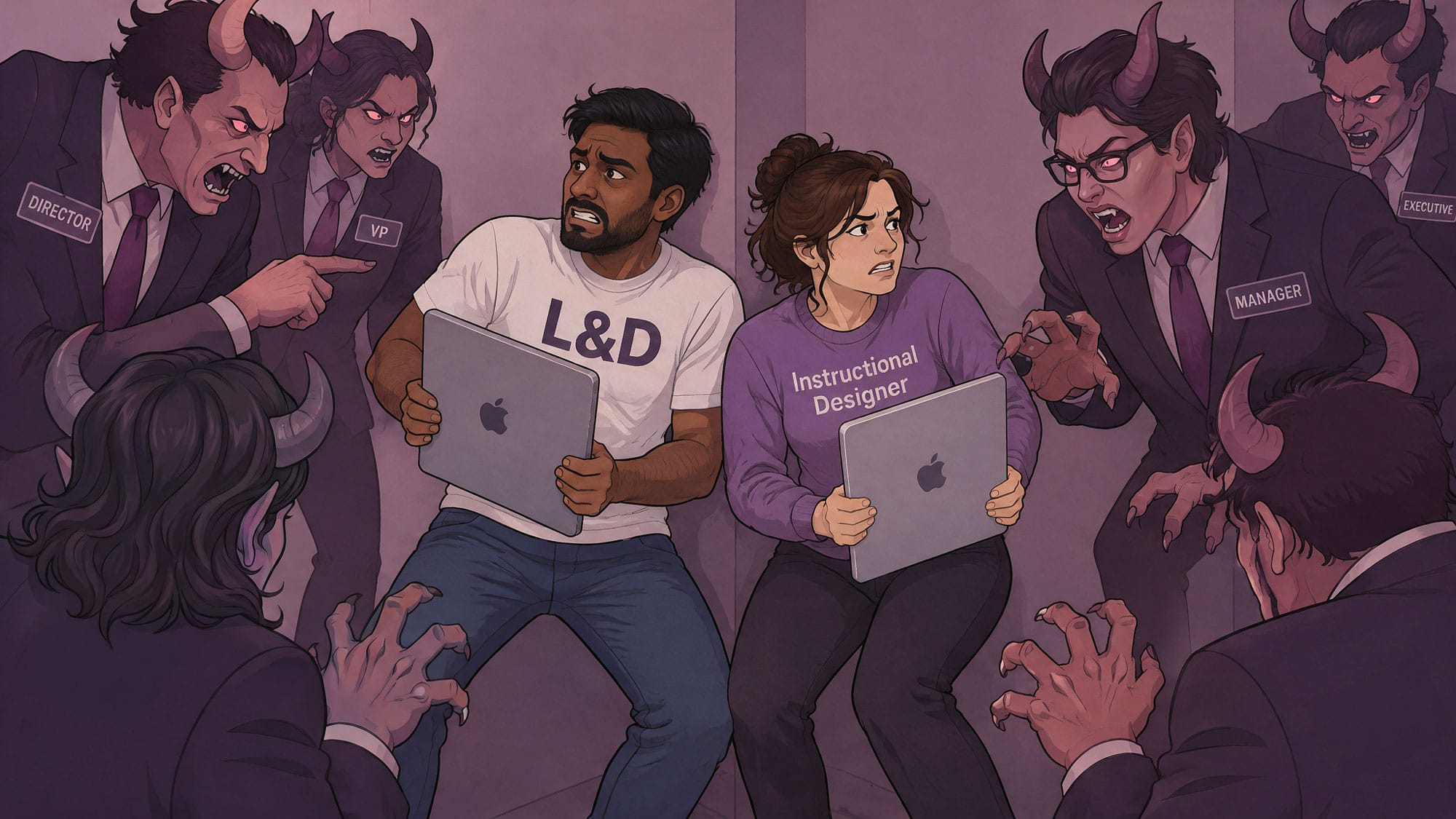
If you are an Instructional Designer or L&D practitioner, you know the feeling all too well. Every day, learning designers are asked to accomplish a near-impossible balancing act: turn dense, dry compliance policies into scaffolded, accessible, and WCAG-compliant modules, all while managing cognitive load and keeping stakeholders happy. It is skilled, virtuous work, and L&D teams do extraordinary heavy lifting with limited resources.
Yet, despite our best efforts and long hours spent polishing interfaces, we often face an uphill battle against learner apathy. How many times have you published a beautifully constructed course only to wonder if it actually shifted the dial for the learner?
The problem is rarely the skill or intention of the learning designer. Rather, standard industry workflows and legacy authoring tools have backed L&D into a corner, stripping away the very elements that make learning human, resonant, and effective.
What We Can Reclaim Together
Instructional designers do not need to be told how to do their jobs, but we do need tools and frameworks that unlock our true capabilities. By supporting L&D teams to restore five core elements to digital learning, we can transform passive course-takers into active, engaged practitioners:
1. Empowering the Subject Matter Expert
L&D professionals know that Subject Matter Experts (SMEs) hold the key knowledge, but capturing their authentic voice without creating huge project bottlenecks is a constant challenge. When an employee takes training on Information Governance or Incident Response, they respond best to the genuine authority of the person who lives and breathes that domain. Giving L&D simple ways to put real SMEs front and center builds immediate learner trust.
2. Illuminating the Real "WHY"
Instructional designers write clear, precise learning objectives every day. But organizational constraints often force us to focus on formal compliance outcomes rather than the human impact. In the classroom, students ask, "Will this be on the exam?" because the outcome matters directly to them. In the workplace, L&D shines when we are empowered to answer the learner’s real question: "How does this help me solve a real problem, protect my team, or save time tomorrow?"
3. Immediate Application: Breaking the "Couch-Potato Stance"
Linear video naturally defaults to what cognitive literature calls the "couch-potato stance", a passive viewing mode where attention strays and processing remains superficial (Cennamo, 1994; Chi & Wylie, 2014; Desai & Kulkarni, 2022). Uninterrupted linear viewing leads to mind-wandering during 39% to 41% of viewing probes (Kovacs, 2016; Zhang et al., 2025).
When L&D teams are equipped to build interactive video segmented into bite-sized chapters with embedded quizzes, contextual resources, and "stop and reflect" scenarios, the learning impact multiplies exponentially:
- Substantial Performance & Understanding Gains: In controlled trials comparing identical instructional content, interactive video with embedded, gated questions elevated average post-test scores to 82.8%, compared to 64.4% for standard linear video (Cennamo, 1994; Desai & Kulkarni, 2022; Navarrete et al., 2025). Attainment at the understanding level of Bloom’s taxonomy jumped by 35.6 percentage points (Navarrete et al., 2025; Ploetzner, 2024; Szpunar et al., 2013). Across meta-analyses, active "learn-by-doing" activities yield over six times the learning benefit of extra passive watching (Koedinger et al., 2015; Zhang et al., 2025).
- Drastic Attention Recovery: Brief, gated questions throughout the video cut mind-wandering in half (down to 19%), while tripling student note-taking and lowering assessment anxiety (Kovacs, 2016; Szpunar et al., 2013; Zhang et al., 2025).
- Higher Participation: Interaction logs show that 74% of viewers attempt embedded video quizzes, whereas assessments placed in separate tabs or external modules are frequently skipped (Kovacs, 2016; Zhang et al., 2025).
- Cognitive Load Optimization: Segmenting videos into chapters under 6 minutes with natural interaction points respects human working memory limits, reducing extraneous cognitive load and preventing split-attention effects (Mayer & Moreno, 2003; Vural, 2013).
4. Championing Authenticity Over Synthetic Polish
Instructional designers understand human connection better than anyone. While recent trends push toward hyper-realistic 3D AI avatars for speed, L&D practitioners recognize that synthetic trainers can fall into the "Uncanny Valley", distracting learners with robotic gestures and unnatural eye contact. Simple, authentic video formats with real people and clear audio create far deeper engagement and trust.
5. Overcoming Legacy Production Bottlenecks
L&D teams are frequently forced into fragmented workflows, juggling 4 to 6 disconnected authoring, design, and LMS tools just to publish a single module. This tool sprawl drains valuable instructional design time away from pedagogical strategy and spend it instead on manual asset assembly.
Empowering the Instructional Designer: The Vidversity PLUS Breakthrough
To tackle these operational friction points, we partnered with Swinburne University on an extensive R&D project focused on re-imagining the authoring workflow. The outcome of that research is Vidversity PLUS.
A common concern among L&D professionals is that emerging automation tools aim to replace or bypass instructional designers. We designed our architecture on the exact opposite principle: the Instructional Designer must remain firmly in the driver's seat.
Vidversity PLUS is built as a true co-pilot to handle the heavy technical friction, production tasks, and governance checks so that IDs can focus on what they do best: pedagogical strategy, storytelling, and learner engagement. The system supports the ID through every phase of creation:
- Scripting & Structuring: The ID applies their expert judgment to refine SME insights and complex policy documents.
- Storyboarding & Review: At each stage, the ID evaluates, adapts, and fine-tunes the learning pathway.
- Automated Assembly: Once the ID sets the parameters, Vidversity PLUS builds the interactive video environment complete with chapters, quizzes, resources, and reflection points directly from those human-directed decisions.
It doesn't replace instructional designers. It elevates them, eliminating administrative overhead so they can create the impactful experiences they envisioned from the start.
Solving the Content Creator Trilemma
L&D teams are constantly caught in a difficult trade-off between Speed, Engagement, and Compliance.
Too often, organizational deadlines force IDs to prioritize compliance and speed over deep engagement. By combining Swinburne-backed research, expert-led interactive video, and human-in-the-loop authoring, we can finally give L&D teams the ecosystem they need to achieve all three without compromise.
Creating great learning is challenging work, but by putting human authority, expert instructional design, and active engagement back at the core of our practice, we can build learning experiences that truly make a lasting difference.
About the Authors
Liz Kollias (BA, LLB) is the CEO and Co-Founder of Vidversity. A former practicing lawyer with over 15 years in private practice, including five years as a law firm partner, Liz brings extensive commercial, legal, and operational expertise to educational technology development. She co-founded CPD Interactive before launching Vidversity, where she brings over 13 years of experience managing online learning consulting, EdTech innovation, and large-scale digital learning projects.
Natalie Wieland (BA, LLB, GradCert InfoSys, Cert IV TAE, candidate PostGradCert Adult Ed) is the CTO and Co-Founder of Vidversity. Natalie has over 20 years of experience in online learning design and delivery across law, healthcare, aged care, and higher education. A former sessional lecturer at Melbourne Law School and founder of CPD Interactive (acquired by the College of Law in 2018), she has consulted extensively to the legal sector on digital platforms and legal research. She founded Vidversity in 2017 to deliver highly secure, domestically hosted interactive learning solutions.
Together, Liz and Natalie have co-authored multiple peer-reviewed academic papers on digital learning frameworks, AI-driven question generation, and video-based learning, including published research in iJAC (2023) and IEEE TechRxiv (2025).
References
Cennamo, K. S. (1994). "Sprouting" the couch potato: Techniques to increase the effort learners invest in video-based materials. Performance Improvement Quarterly, 7(2), 62–80. https://doi.org/10.1111/j.1937-8327.1994.tb00627.x
Chi, M. T. H., & Wylie, R. (2014). The ICAP framework: Linking cognitive engagement to active learning outcomes. Educational Psychologist, 49(4), 219–243. https://doi.org/10.1080/00461520.2014.965823
Desai, T. S., & Kulkarni, D. C. (2022). Assessment of interactive video to enhance learning experience: A case study. Journal of Engineering Education Transformations, 35, 74–80.
Forkan, A. R. M., Kang, Y. B., Jayaraman, P. P., Du, H., Thomson, S., Kollias, L., & Wieland, N. (2023). Video based digital learning framework using AI question generation and answer assessment. International Journal of Interactive Mobile Technologies (iJAC), 16(1).
Kang, Y. B., Forkan, A., Banerjee, A., Jayaraman, P. P., McCosker, A., Kim, S., Wieland, N., & Kollias, L. (2025). Comparative analysis of large language models for automated question generation from video-based learning content. IEEE TechRxiv. https://doi.org/10.36227/techrxiv.174195543.38933530/v1
Koedinger, K. R., Kim, J., Jia, J. Z., Zhao, E. A., & Bier, N. L. (2015). Learning is not a spectator sport: Doing is better than watching for learning from a MOOC. In Proceedings of the second (2015) ACM conference on Learning @ Scale (pp. 111–120). ACM. https://doi.org/10.1145/2724660.2724681
Kollias, L., & Wieland, N. (2020). Online learning before, during and after COVID 19, observations over 20 years. In Proceedings of the International Conference on E-Learning and Automation (ICELA 2020).
Kovacs, G. (2016). Effects of in-video quizzes on MOOC lecture viewing. In Proceedings of the third (2016) ACM conference on Learning @ Scale (pp. 31–40). ACM. https://doi.org/10.1145/2876034.2876041
Mayer, R. E., & Moreno, R. (2003). Nine ways to reduce cognitive load in multimedia learning. Educational Psychologist, 38(1), 43–52. https://doi.org/10.1207/S15326985EP3801_6
Navarrete, E., San Pedro, M. O. Z., & Baker, R. S. (2025). A closer look into recent video-based learning research: A comprehensive review of video characteristics, tools, technologies, and learning effectiveness. International Journal of Artificial Intelligence in Education, 35, 1631–1694.
Ploetzner, R. (2024). The effectiveness of enhanced interaction features in educational videos: A meta-analysis. Interactive Learning Environments, 32(5), 1597–1612. https://doi.org/10.1080/10494820.2022.2153147
Szpunar, K. K., Khan, N. Y., & Schacter, D. L. (2013). Interpolated memory tests reduce mind wandering and improve learning of online lectures. Proceedings of the National Academy of Sciences, 110(16), 6313–6317. https://doi.org/10.1073/pnas.1221764110
Vural, O. F. (2013). The impact of a question-embedded video-based learning tool on e-learning. Educational Sciences: Theory & Practice, 13(2), 1315–1323.
Zhang, Y., Li, R., Pi, Z., & Yang, J. (2025). Active learning strategies in video learning: A meta-analysis. Educational Research Review, 48, Article 100708. https://doi.org/10.1016/j.edurev.2024.100708




Member discussion