
My AI Toybox

MY AI TOYBOX How I use Generative Artificial Intelligence
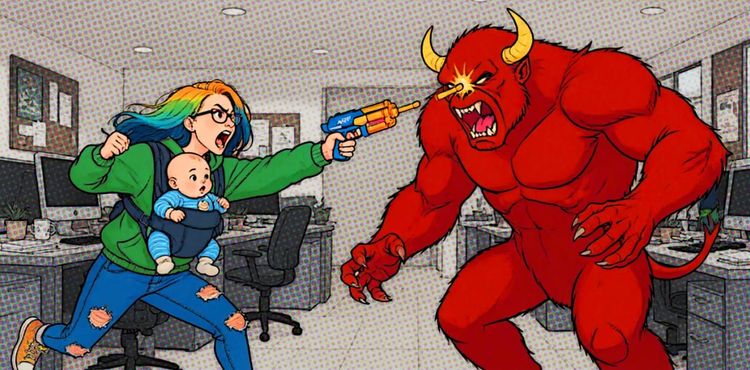
Be honest - we're all using generative AI more than we admit. Did you really write that emoji-laden blog post yourself? Did you come up with those perfectly-structured learning outcomes without asking ChatGPT? This week, as Dee continues to fight Disarrai, the demon of Artificial Intelligence, I lay bare exactly how I use AI to help me create Hell and D, and in the day job as a learning content creator.
I’m one of those pretentious bastards that subscribes to the theory of the Xennial micro-generation, i.e. people born between 1977 and 1983, who experienced an analogue childhood, and then hit their teenage years just as mobile phones and the internet started to become a thing and turn us all into doom-scrolling, dopamine-addicted zombies. Too young to be Gen X and too old to be a Millennial, it’s also referred to as “The Star Wars Generation” based on the original trilogy being released between ’77 and ’83, so I’ll happily claim to be a part of that. Without turning this into one of those nostalgia memes that talk about playing out until the streetlights came on, my point is, my childhood screen time was limited to the hours of 4pm ’til 5:30pm weekdays, and maybe Saturday mornings, when I would mainline He-Man, Transformers and Ninja Turtles. Outside of that, my only tools for entertainment were a handful of action figures, some cardboard boxes, and my imagination. And it was epic, right up until 1998, when my first experience of a tech explosion hooked its claws into me via home internet, a free Philips BT Cellnet phone that came with my student bank account, and a slippery slope to an arthritic thumb.
Fast-forward into adulthood, and it all feels a bit déjà vu. I’ve worked in design and copywriting for around 25 years, and I’ve used those skills in the L&D world for coming up to a decade. That’s a good portion of my career relying on the equivalent of a handful of action figures, cardboard boxes and my imagination to get paid. And then, like mobile phones and the internet back in the 1990s, AI entered the chat and began writing courses, creating stock images, and killing off the voiceover industry. Now of course, like many of my peers, I harbour the existential dread that AI will also come for my job as a learning content creator, but I try and balance this against the fact that AI is allowing people to create awesome things that just wouldn’t be possible without it - not because AI can create better output than humans but because of the time and cost saving it delivers for individuals and organisations (and yes, I’m well aware there is an environmental cost to all of my prompt-bashing activities).
The scary part is, there’s no going back from this - as much as I want my 2 young kids to have the screen-free childhood I retreat to, as 46-year-old me bids on another Batman: The Animated Series action figure from ebay that I never managed to convince my mum to buy me in 1992, the reality is that Minecraft on a tablet, or Coco-effing-Melon on YouTube, is how my children live their childhoods. And I have no room to talk - just as I embraced the internet and the mobile phone, I’ve ignored any lessons I could have taken from those experiences and blindly jumped on-board the AI train, doing things, that as a designer and writer, I’m not proud of. But didn’t we all do that? That fact that I stopped short of prompting ChatGPT to generate an image of me as an action figure last year is something I’m taking as a win.
A few years into the Artificial Intelligence explosion, hindsight allows me to look back at all the shite I asked ChatGPT, Gemini, and Firefly to create/generate/steal for me, and take stock. Why did I use a machine to write something for me that I was perfectly capable of penning myself? Why did I use spend 3 hours text prompting to make a logo I could have made in InDesign in 10 minutes? It’s the illusion of saving time but, like most creative processes, there’s a learning curve that means initially, you’re going to waste a lot of time just figuring out how to do something, and then realising it really wasn’t worth it. We’re currently in the era of AI slop and depending on your feelings and motivations when it comes to generative output, you’re either going to continue signing off on the first janky thing Claude spits out, or you’re going to realise that AI is a merely a tool, and you need a degree of skill to use it responsibly and intelligently, or not at all.
So in a show of complete transparency, let me talk you through how I’ve used AI in the past and how I use it today, not just to help with the creation of Hell and D, but also in the day job as a learning content creator. And let me be judged accordingly!
The pen is mightier than the prompt
Seeing as I’m typing this out right now, let’s get the big one out of the way - using AI in writing. If we go way back to 2022, I was working in a small eLearning company where we were messing around with all the new AI tools that were exploding onto the scene. I’d been writing L&D blogs for the company website for years but nothing inspiring or original - Top 5 ways to… kind of thing. It was boring but it was the only regular fresh content our website saw, as case studies were few and far between due to the long lead times we had on projects. Then ChatGPT happened. This thing could write blogs in seconds. I wasn’t concerned about tone of voice, I just wanted it out there, and AI delivered. After knocking a few of those out, I started to wonder if it could write more long-form, in-depth articles - and it could. We’d talked for a while about a 90s style video game magazine focused on eLearning - could we get ChatGPT to help us make this a reality? We’d write a few “hero” articles ourselves, then use AI for filler pieces.
Before it was ever called “Dirtyword”, the little e-learning magazine that could, had a working title of “Glitch” and we used AI to write some test articles and generate a couple of covers and interior visuals. They were okay. The articles were very straightforward but lacked personality, and this early on in AI, it was difficult to work that in. So we made the decision that all of the articles would be written by us, and made a plan to try and get other contributors on board. I have a sneaking suspicion some of the early guest writers in Dirtyword may have used AI but I never called anyone out on it, as we were just happy to have the content.
For the 2 years we published, it was easy, and enjoyable, to write about things I was knowledgable in and recount some anecdotes from my time in the industry. However, I’ll hold my hands up to using AI to generate some initial article ideas in the quieter months when the creative juices had dried up, or when I was so busy with paying work that my mind wasn’t 100% on the magazine pages I needed to fill. But I always made sure to only use AI as a starting point - ideas and research (verified afterwards of course) were fine, but the actual writing came from me.
And now with Hell and D, I’ve scaled it back even more - if I have nothing to say in an area I know nothing about, I don’t touch a single key on the MacBook. The beauty of an online magazine is that the monthly “page count” can be as many or as few pages as it needs to be, so I’m not stressing on getting out 4 articles if I only have 2 in my head. These days, AI is my proof editor - I use it for flow, ensuring I’m not doubling up on points and telling me when to murder those darlings (although I reserve the right to ignore Gemini and keep any instances of waffle I deem worthy).
When it comes to the day job however, things are a little different. Businesses, and the software they use, are actively encouraging staff to use AI on a daily basis at every opportunity. It’s hard to make a case for spending a day writing a decent blog or case study when the guy on the next desk can do it in 30 seconds. And let’s be honest - who’s reading business blogs and case studies these days? Probably just another AI, to rank you in an AI-based algorithm. Unless there’s a specific business need to produce human-originated content that’s going to get your customers excited and lead to a rise in your salary, is the average person really going to spend longer agonising over every word of a piece of text, as opposed to using AI, when they get paid the same regardless?
Aside from the marketing SEO fluff, writing for actual learning is different. The way I used to write online courses was a combination of the client sending over the information, some discovery meetings, input from SMEs and then me sitting down to work out learning outcomes and what went where. Sadly, these days, most customers don’t see the value in spending the time and money to do this, when they can just send over their own AI-gen scripts, and skip the cost of the discovery stage. So as much as I prefer the traditional process, and advocate for it, sometimes budgets, deadlines and clients dictate that if you can’t beat ‘em, join ‘em.
Pixel theft
This is the contentious one - nobody wants to be accused of stealing somebody else’s artwork, and the argument for whether AI-generated visuals are theft rages on. As a designer, I completely see where artists are coming from on this, as Artificial Intelligence has, without question, been trained on the drawings, paintings and animation from artists across history, without any sort of compensation being offered. And the uptake from individuals and organisations using AI to generate visuals has seen the demand for human-generated art and design plummet. The problem is that, give or take the odd extra finger, it’s really really good, and such an enticing proposition for people who have zero artistic skills but who fancy themselves an artist.
Again, for me, prompting an AI to create art doesn’t quite hit the mark - I like to see my hand in a finished piece and letting AI take the reins offers no satisfaction. I’ve been drawing my own comic characters since I was a kid, with dreams of one day getting to see those characters in print. I never got to work for DC or Marvel but Hell and D at least gives me an outlet. And I’m going to be honest - AI does play a large part in creating the final images you see on the website. Why? The short answer is, unsurprisingly, time and money. Hell and D is a passion project, created outside of the day job and squeezed between the ticks of a second that I can find between being a husband and a dad. It costs money to run it and nobody involved gets paid - all Hell and D contributors do it for the love. So after getting the articles written, there is barely any time left in the month to create all-original art, nor to pay an artist to do it.
So how can I claim to create my own art but still use AI?
The characters, such as Dee, are all hand-drawn by me, as I channel 12-year-old Mark with dreams of one day pencilling Batman. I draw them with different expressions and poses, before photographing them and dropping them in Illustrator and Photoshop for tidying up the lines and to hint at the colouring - no AI involved, just skills I’ve honed since university in 1998. Then, once I have a bank of between 10-12 images that I’m happy with, I upload them into Magnific (formerly Freepik) and use those images to train the AI to consistently render the character whenever I tag @Dee in a prompt. So prompting “@Dee winking at the camera, holding a flaming lightsaber as a shadow demon sneaks up behind her. Background is a stone-build tunnel. Colours are pinks and purples.” will see the AI using my character of Dee, plus a reference image I’ve uploaded of a shadow demon, to generate 4 visual iterations for me to use. None of them are ever perfect, so I usually take my preferred one back into Photoshop for touch ups.
So yes, there are undoubtibly elements of the image that AI has nicked from elsewhere - the composition, lighting and camera angles are the immediate ones I can thank it for - but the characters and any other prominent objects in the image have all originated from me, long before the machines got involved. Everyone will have their own take on the ethics of this but for me, I can sleep soundly at night and still have a sense of ownership in the finished product.

And what about the 9-5 L&D work? The projects I used to work on were generally lower budget, so I would make use of stock photography, meaning somebody, somewhere was getting paid a small amount every time I downloaded one of their photos. What was always frustrating about stock photos was the lack of diversity in terms of people and a complete dearth of images for anything UK-specific such as Police or the NHS. AI was a god-send for solving this - I can now show people of all skin colours tooling around in a British Police car. It’s a massive win for representation in compliance training, even if it comes with the lingering guilt that I’ve taken food off a stock photographer's table.
Again, if the imagery really matters, and if the client budget is healthy enough, I will always push to use real people, photographers and film. But often in learning projects, the visuals are an afterthought, purely there to alleviate the tedium of text walls - if customers can get away with learners reading a few paragraphs before taking a multiple choice question, they will. And at least AI-gen imagery is one step up from the days of clients asking, “can’t you just use something off Google?”
Synthesia slaughter
Out of all the AI tools I use, this is the one I feel most conflicted about, and thankfully, not one I’ve ever had course to use for Hell and D. The day job, though, is a different matter. When I began working in e-learning, presenters were a good trick to have in your back pocket to make learning content more “engaging” for your audience. If you could find someone with personality and the ability to read an auto-cue clearly, you were on to a winner, as it meant you could take walls of dry, often dull, text and inject a bit of life into them by way of an enthusiastic, smiling presenter. And even if you didn’t want to see their face, a good voiceover artist could provide the lift that your boring course on Cyber Security so desperately needed. I imagine that life as a freelance e-learning presenter was pretty good up to around 2021.
My evidence for the death of the presenter industry in 2026 is anecdotal and taken from the begging messages I see on LinkedIn and receive in my inbox, but it would seem that software such as Synthesia has swept the legs out from those whose livelihoods depended on their voice. Presenters were always a “nice-to-have” and one of the first things that clients cut from their budgets pre-AI. When customers realised they could have their cake and eat it by using cheap AI voices, the rot set in. In an ideal world, all projects would use real people, but budgets, timelines and the perception of value often mean I am forced down the Synthesia route. Yes, it still has a hint of uncanny valley but, as with all AI, it has massively improved in the last couple of years, with the introduction of gestures, facial features and altering the tone of voice to fit the mood of the script. It feels like artists, designers and copywriters can still fight their corner and beat the drum for human-created content but with presenters it already feels like the fight is over - although I would love to be proven wrong on this.
And that my friends, is where I stand on Artificial Intelligence use today across the areas I work in. When it comes to the day job, there’s an element of being beholden to the wishes and budget of the client, but I advocate for the use of real people and creators wherever I can.
For Hell and D, I try to be as ethical as possible in my use of AI tools, essentially using it only for proofing text and compositing images of my own characters. I appreciate that for some, that’s still a prompt too far, but I balance this with the fact that without AI, there would be no magazine at all, as I just wouldn’t have the time. At heart, I’m still a kid making stories with action figures and cardboard boxes - but I make them quicker with AI.
Mark Gash is a creative content lead for elearning, who believes there has to be more to training content than just clicking a next button.
Connect with him here: https://www.linkedin.com/in/markgash



Member discussion