The Day I Started To Sound Like An AI Chatbot
THE DAY I STARTED TO SOUND LIKE AN AI CHATBOT Linguistic Choices in Learning Experience Design
When people interact with courses or modules that “sound like AI”, what is the impact on the effectiveness of their learning experience?
I design learning experiences — for humans
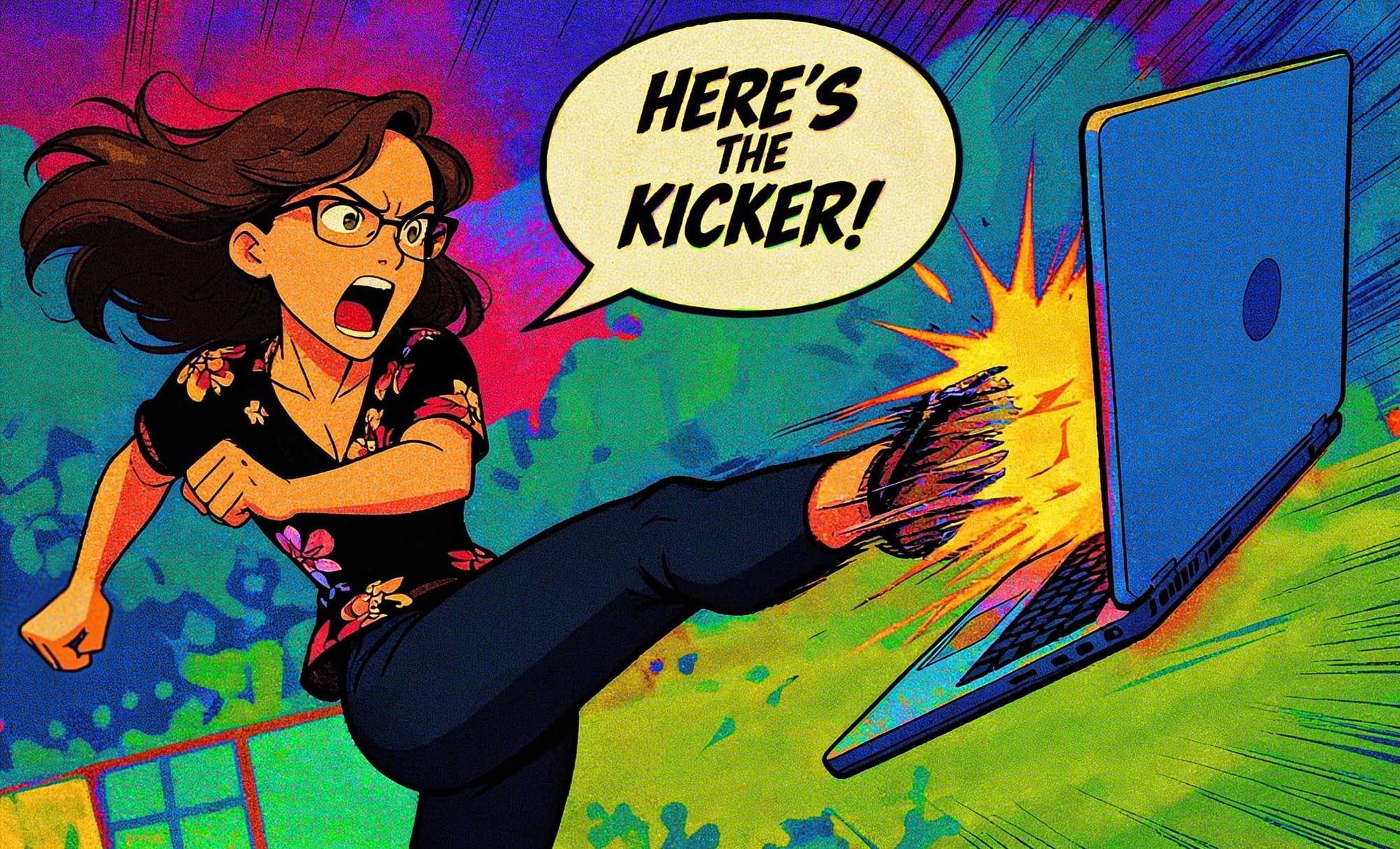
The other day I was having a in-person conversation. While telling a story, I heard myself say, "But here's the kicker!" Immediately followed by a horrified pause, "Oh no, I sound like ChatGPT…”
Chatbots have already "tainted" so many linguistic choices. As the Dead Internet Theory comes alive (pun intended), we question: Is this real? Was that written by a bot? Is it credible or is it AI? (A curious question, considering humanity's history with credibility.)
So when people interact with courses or modules that “sound like AI”, what is the impact of the effectiveness of that learning experience?
• Does a module lose credibility when it uses a lot of em dashes?
• What about words like "essential" or "crucial" or "vital"?
I find myself avoiding those “AI slop-esque” words when writing, even though they're perfectly good words. Words that existed prior to 2023 when ChatGPT became popular.
Yet, as AI models become better at mimicking human speech, those tell-tale “signs of AI” go through their own evolution. Over time, the em dash became less of a sign of AI writing because newer versions of chatbots don't use it as much — and people outside of academia have started to embrace it.
The ellipsis has also evolved... It went from being fashionable to "old person punctuation". Then it became en vogue again when ChatGPT started using it more...
The evolution of language: our stories in words
Languages have evolved for as long as humans have existed. Shakespeare's advice "to thine own self be true" still gets quoted today but when was the last time you used "thee" or "thou" in casual conversation?
One aspect of language evolution is the influence of migration. For example, Ladino is facing extinction and yet kept alive with music. (Listen to an example of a Ladino song.) With a blend of Spanish, Portuguese, Hebrew, Aramaic, Turkish, Greek, Arabic, and several Balkan languages, Ladino tells the story of people who migrated across those areas. It’s like fusion cuisine with words.
By contrast, Anishinaabemowin (Ojibwe) — one of the North American Indigenous languages with a broad geographic reach from Manitoba to Québec and the Great Lakes area — has evolved into local dialects that all have shared roots. (Listen to a Knowledge Keeper explaining the four levels of Anishinaabemowin language.)
Another example of human migration influencing language is New Brunswick, the only Canadian province that is officially bilingual, where French and English are often mixed in the same sentence. Franglais (also known as Frenglish) is also common in Montreal in Québec, but the New Brunswick Chiac dialect sounds different from the Montreal version of Franglais.
You probably have your own dialect or inside jokes or phrases that you only use with people in your personal life, your own private version of code-switching.
All this is to say that our languages reflect our stories. Human stories.
What exactly makes us human?
My brain had to go through several iterations of learning new languages. It was hard at first but now it's fun. It tickles my brain. Comprehensible input supports language learning. Wait, am I an LLM? Are you?
For bilingual humans, it’s not uncommon for our brains to randomly mix words between languages, especially when it’s late and we are tired. AI doesn't get tired. AI wouldn't do that. So perhaps these “mistakes” are what makes us human? AI can be prompted to add errors, but there will always be a mathematical calculation and consistency to its mistakes.
Humans are messy and unpredictable in ways that AI isn't — yet.
So why did I find myself judging the words, "But here is the kicker!”
With AI contributing to the comprehensible input for our brains, aren't we all collectively starting to "sound like AI"? I looked it up and found that etymologist Adam Aleksic explored this phenomenon in a TED Talk: Why Are People Starting to Sound Like ChatGPT?
Linguistic choices in teaching
Okay, so what? What does all this mean for learning experience design? How can we write content that is truly human, and not just based on an algorithm?
As you ponder these questions, I invite you to consider that the concept of "not human" learning experiences existed before LLMs. With asynchronous eLearning, there is a long history of uninspiring modules. eLearning pioneer Michael Allen has been on a quest to eradicate "boring eLearning" for over two decades. At the core of his eLearning manifesto is the value of human experience in the process of learning.
Is your eLearning human?
What about you? Do you sound like ChatGPT? Curious to see if anyone else has experienced this in real life? (Wait, I'm doing it again...)
• What words or phrases did AI "ruin" for you? Do you avoid using them when creating learning materials?
• Do you embrace the em dash — or do you abhor it?
And most of all, through the language choices in your learning designs, what human stories are you telling?
P.S. The above text was created 100% by a human, just like grandma used to make. You could say it's hand-crafted and artisanal. For humans.
Written by Katarzyna Kochany. Katarzyna Kochany is an Instructional Designer and eLearning Developer.
Connect with her here: https://www.linkedin.com/in/katarzynakochany/

Member discussion