
Fork the System: Programming Was Women’s Work Until Men Realized It Paid Well

FORK THE SYSTEM Programming Was Women’s Work Until Men Realized It Paid Well
We are often told that women left programming because they were not interested, were not good at math, or simply chose other careers. That story is convenient, but it is not true.
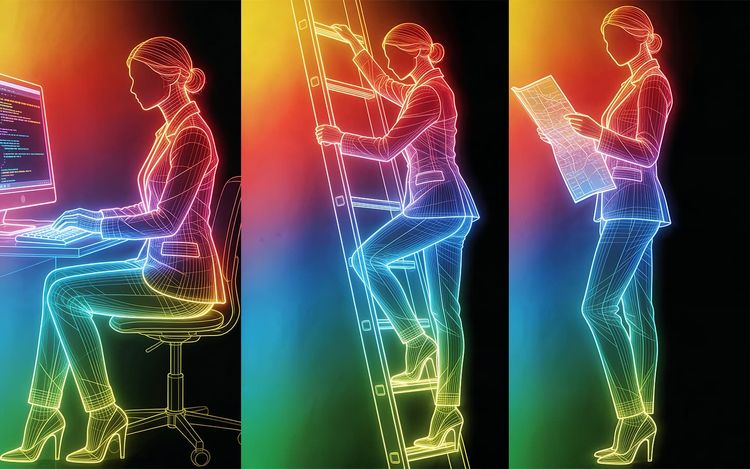
Programming was not originally perceived as a masculine or elite field - it began as women’s work. In the 1940s and 1950s, computing was considered clerical labor. It was repetitive, detail oriented, low status, and not worth men’s time. So women were hired to do it. They were employed not because institutions believed in gender equality, but because the work was dismissed. Ironically, this labor required extraordinary skill, including logical abstraction, systems thinking, mathematical reasoning, and error detection, long before programming languages or formal documentation existed.
The earliest programmers were women who wrote the first code without manuals, learned machines from wiring diagrams, and debugged systems through logic alone. Yet when these machines were presented to the public, the women who programmed them were not introduced, credited, or remembered. Some were literally cropped out of photographs. The story quickly became one of male inventors and lone geniuses, even though women had made the machines functional in the first place. This erasure was not incidental. It shaped who would later be seen as authoritative and legitimate in computing.
Women continued to do foundational computing work for decades. During the space race, they were employed as human computers, performing complex calculations by hand for military and space missions, including trajectory calculations critical to putting men on the moon. As electronic machines became more powerful, this work transitioned into programming. As the discipline gained visibility and strategic importance, it was reframed. Programming was no longer clerical. It became engineering.
By 1984, women made up 38 percent of programmers in the United States. This peak coincided with a major shift in the industry. Software had become profitable. Computing was no longer a support function. It was a core economic engine. Almost immediately, the field began to professionalize in ways that excluded women. Companies adopted aptitude tests that favored math coursework men were more likely to have been encouraged to take, screened for narrow personality traits framed as signs of brilliance, and redefined merit to mirror the people already in power. By the mid 1960s, around 80 percent of companies were using these biased tests as their main hiring tool.
At the same time, access to computing outside the workplace became gendered. In the 1980s, home computers were marketed as toys for boys. Advertisements overwhelmingly showed boys using computers for homework and games, while girls were absent. Parents bought computers for their sons, not their daughters. When a family owned one machine, it was often placed in a boy’s room. Boys entered university with years of hands on experience, while girls were told they were behind, not because of ability, but because of access.
Today, women make up about 28 percent of programmers. This is a smaller share than they held forty years ago. During the same period, the industry grew from roughly half a million jobs to around five million. As computing expanded, wealth and influence concentrated, and women’s representation declined. This did not happen despite growth. It happened alongside it.
This was not an accident. When programming was seen as secretarial work, women did it. When it became prestigious and profitable, women were systematically pushed out. The pattern is clear. Money shows up, and women are excluded. If we want to understand gender inequality in tech, we do not need myths about interest or aptitude. We need to follow the money and be honest about how the system was forked on purpose.
The Question That Remains
The question now is whether learning and development will mirror the same downfall. As new fields gain legitimacy, funding, and institutional power, we have to ask whether they will follow the same trajectory, welcoming women when the work is undervalued and quietly pushing them out once it becomes prestigious.
The Fate of Women in Computer Science
For my part, I want to add something personal. From the time I was three years old, I was constantly on computers. Technology was not something I discovered later in life. It was always part of how I learned, played, and thought.
When I tried to join an engineering class as a child, the assumption was immediate and cruel. I was labeled as an "alien" by the boys. Other girls pushed me into the boys’ toilet because I did not fit their idea of what a girl should be. I was told repeatedly that I was not normal because I never played with Barbies. I played with action figures. I played video games. I had a Game Boy. I was told, explicitly, that it was called a Game Boy, not a Game Girl.
As I grew older, the comments changed shape but not substance. Men told me that women are too emotional for computing, that women are naturally less technical, that doing research somehow made me abnormal.
What remained consistent was the message that deviation would be punished. Interest had to be justified. Competence had to be proven repeatedly. Passion was reframed as threat. Over time, this constant invalidation begins to resemble the fate of Ophelia. Not madness as weakness, but madness as a response to being gaslit, silenced, and pushed toward the margins for refusing to perform an acceptable version of femininity.
The danger is not that women are too emotional for computing. The danger is that systems repeatedly pathologize women who do not comply, then use their survival responses as evidence against them.
Biography:
Dr. Asegul Hulus is an Assistant Professor in Computer Science and a Fellow of the Higher Education Academy (FHEA). She is a distinguished researcher and published author with expertise across multiple Computer Science disciplines. She serves on the ACM Council on Women in Computing (ACM-W), where she is an investigative journalist and is on the Global Chapters Committee. She is also the founder of MetaTech Feminism, a pioneering framework at the intersection of technology and feminist research.



Member discussion